
Small nonprofits doing some of the most important work in their communities are racing every day just to stay afloat, and too often the donors who would gladly support that work never hear about it. Donor attention and dollars have traditionally gone to large, established organizations, and that gap is only growing wider. In 2025, nonprofits with budgets over $10 million grew revenue 12%. Mid-sized organizations grew just 2%, and those under $1 million saw revenue fall 6% (Blackbaud Institute, 2025).
Major gifts help explain a large part of this divide. Large organizations received 85% of annual revenue from major gifts, compared with 52% for small organizations. Landing major gifts has long depended on development staff and well-connected boards, and most small nonprofits have neither.
But what if donors could find you based on the impact of your work, not the size of your development office? New donor-facing tools are starting to make that possible. The nonprofits that benefit will be the ones that make their impact visible, not just to people, but to the tools donors now use to search.
Giving Compass Explorer
For the past few months I’ve given feedback and early reviews to the developers at Giving Compass. Giving Compass is a Seattle-based nonprofit that helps individual donors and donor advisors research, evaluate, and connect with community-led nonprofits. Its new tool, Compass Explorer, is an AI research assistant for donors who want to give thoughtfully.
Plenty of tools show nonprofit tax filings, but Compass Explorer goes much further. It brings together years of IRS 990 data (financials, leadership, programs, and grant history) with annual reports, press releases, public impact stories, and Charity Navigator ratings. It puts the numbers, the story, and the evidence in one place, in front of donors who are actively looking for causes to support.
In the past, donors had to piece that picture together themselves, or rely on an advisor or a friend on the board. Now these tools assemble it for them, giving organizations a real chance to shape their own story. Organizations that put their impact on the record and make it easy to find are the ones like-minded donors will discover, and turn into partners.
Donors are already making this shift
In November 2025, Charity Navigator launched Horizon AI Search, powered by Giving Compass Explorer. In its first pilot phase, Horizon search handled more than 22,000 searches and the results were telling, according to a case study from Giving Compass and Charity Navigator:
- Most donors started with a cause: about 80% of searches were about an issue they cared about.
- Donors who used AI search completed gifts at twice the rate of other visitors, and intent to donate rose 64%.
- Results were well-matched to donor intent and pointed to nonprofits of all sizes. In this arena, a small community organization can appear alongside a national one, but only if its information is there to find.
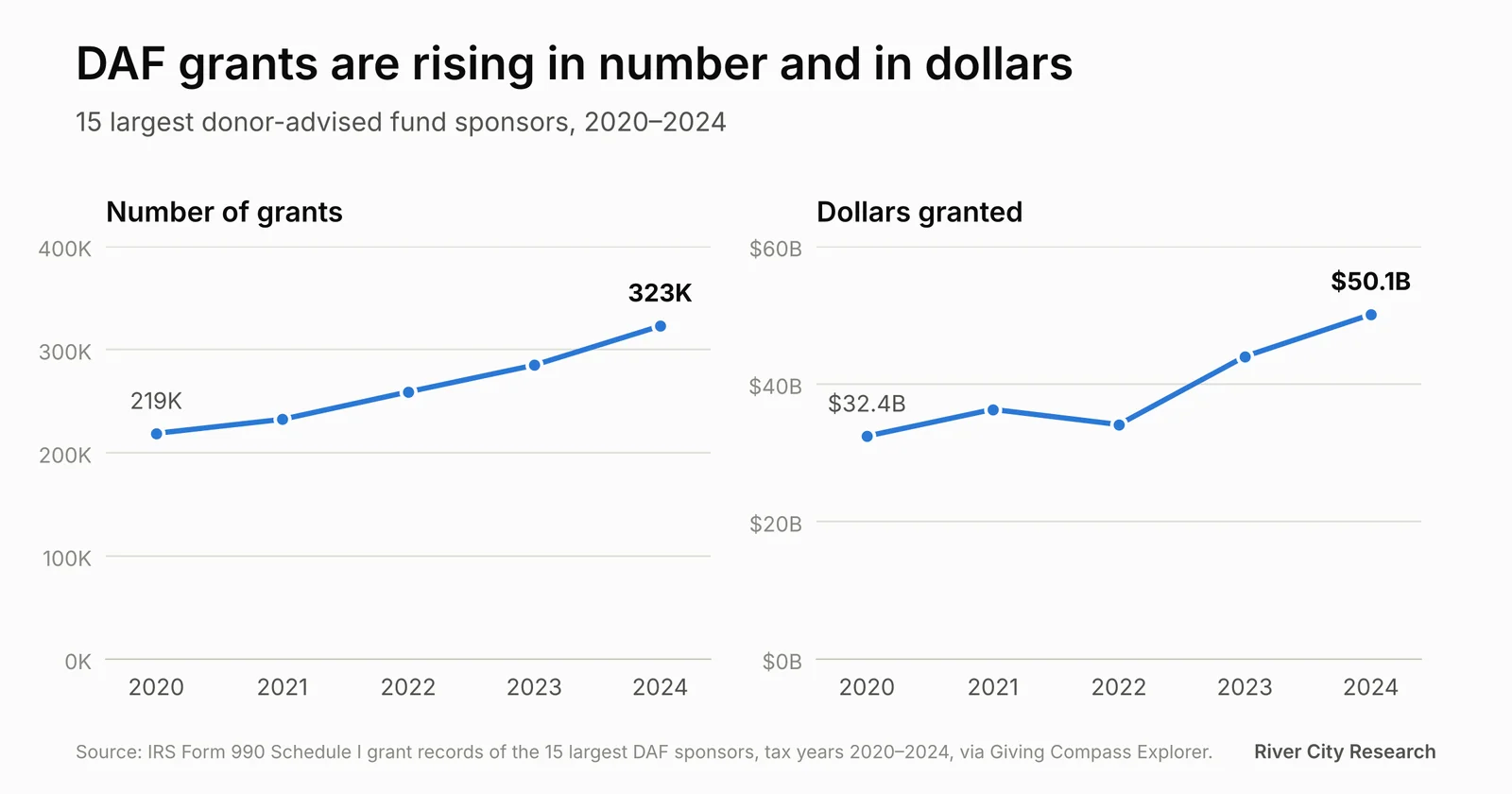
Major gift donors have the most reason to use these donor-facing tools. Donor-advised funds (DAFs) are the fastest-growing vehicle in American philanthropy, holding $326 billion in assets and granting nearly $65 billion in 2024. The 15 largest sponsors alone made more than 320,000 grants worth $50 billion that year. The donors and advisors who direct that money, along with family offices and community foundations, want evidence and reassurance before they give to an organization they don’t know. More and more of that vetting happens online, through ratings, profiles, and donor-facing tools, and AI search makes it faster to scan regional nonprofits than ever before. Without a complete profile, organizations can be filtered out before the first conversation.
How nonprofits can prepare: six steps
The good news: becoming visible to donors doesn’t take a development department. Most of it comes down to putting what you already know about your impact where donors and their tools can find it. Here are some first steps:
- Publish impact reports as web text. Build a searchable HTML impact page with recent data and clear results. Search engines and AI discovery tools frequently fail to index text buried inside designed PDF downloads or graphic images. HTML text makes it more likely that LLMs and web crawlers read every result.
- Make your 990 match your story. Describe programs and results in Part III of the 990 the same way your impact reports do. Indexers read the 990 first.
- Claim and complete your Candid and Charity Navigator profiles. Add goals, metrics, and results, and update them every year.
- Publish outcomes from your grant reports. You have already prepared and delivered a grant report. Pushing your results online can broaden the reach.
- Keep it consistent. When your website, 990, and profiles say the same thing, donor-facing tools are more likely to present a clear, accurate picture.
- Check that search engines can find you. Set up free accounts in Google Search Console and Bing Webmaster Tools, submit your sitemap, and confirm your impact page is indexed. Then check back each quarter to see which searches bring people to your site.
Each step is manageable on its own, but together they take time and focus that small teams rarely have to spare. That’s where outside help can make the difference.
How River City Research can help
River City Research helps nonprofits turn the evaluation and program data they already collect into impact information that funders can find. We can:
- Audit your visibility. We review your 990, website, Candid profile, and Charity Navigator profile, then search for you the way a donor or AI tool would.
- Define outcomes and metrics. We help you write the goals, strategies, and year-by-year metrics that Candid’s Platinum Seal asks for, using data you already have.
- Prepare your Charity Navigator Impact & Measurement submission. We document your outcome measurement practices for the Measuring Outcomes assessment and, for eligible programs, build the cost-per-outcome analysis.
- Build a web-ready impact page. We format your results for the web, so funders can read them and search tools can find them.
- Keep it current. An annual refresh keeps your profiles in step with each new 990 and grant cycle.
Make sure funders can find you
Donor-facing tools are changing how small and mid-sized nonprofits share their story and connect with funders. Organizations that share their impact across these platforms will be ready when interested donors come looking. Contact River City Research to see how visible your impact is today, and how to make it easier to find tomorrow.
Sources
- Compass Explorer, Giving Compass
- Charity Navigator Launches Horizon AI Search, Charity Navigator, Nov. 24, 2025
- The New Nonprofit Visibility Gap, Stanford Social Innovation Review, Oct. 29, 2026
- DAF Assets Soar 30% to $326 Billion, Chronicle of Philanthropy (Annual DAF Report 2025)
- Network Connections and Competitively Awarded Funding, Faulk, Willems, McGinnis Johnson & Steward, Public Management Review, 2016
- 2025 Trends in Giving, Blackbaud Institute, 2026
